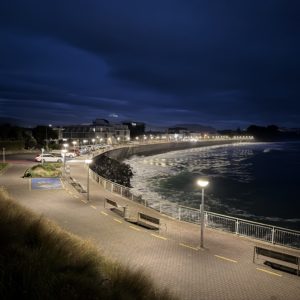
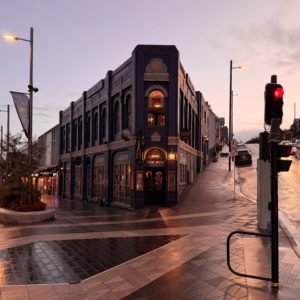
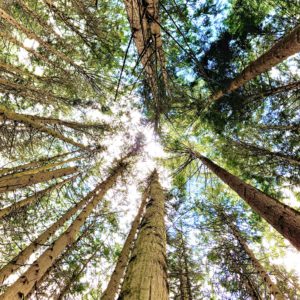
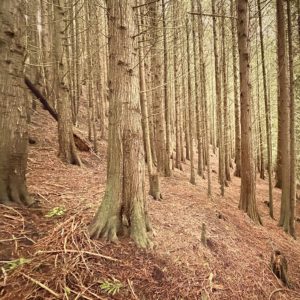
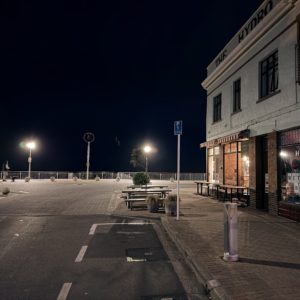
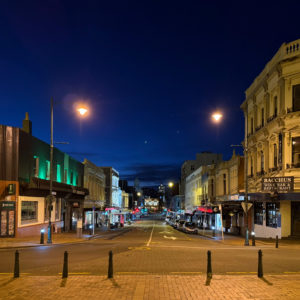
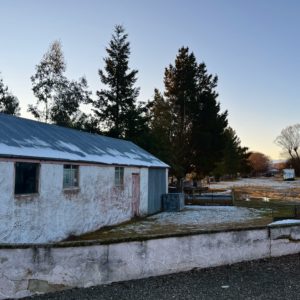
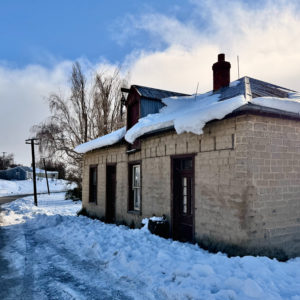
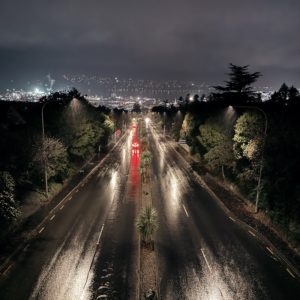
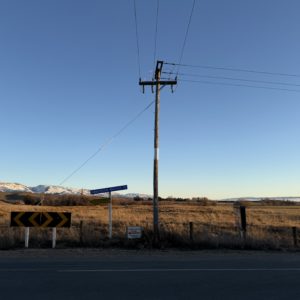
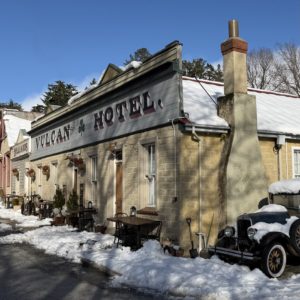
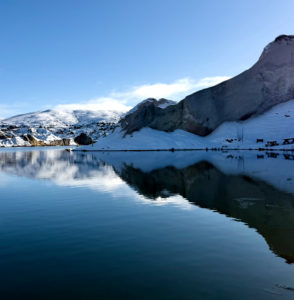
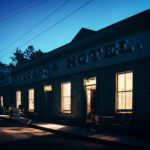
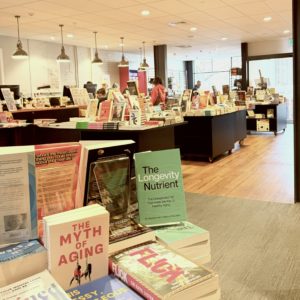
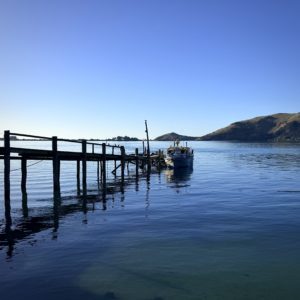
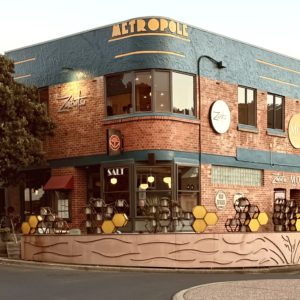
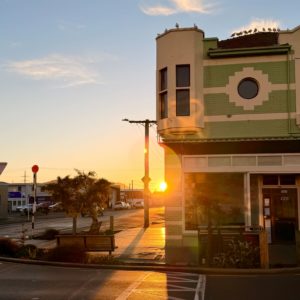
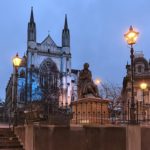
Here is another update from what I call my “Live Feed” on a page here on my photoblog. Just for the record, there’s no pattern or schedule to when I post on this page, only whenever something takes my fancy.
Above is a selection of photos to get you interested, or you can head over to the page right now using this link: Live Feed
A number of years ago, when I was living in Auckland, I was told that when it came to the weather, it was either about to rain or it had just rained. This meant you were generally in one of two states: making sure you had something to keep yourself dry, or trying to dry something that had recently got wet. To be fair to dear old Auckland, it isn’t entirely true. It has its fair share of fine days and, unlike down here in the South Island, it rarely gets properly cold. You don’t often have to worry about waking up to temperatures several degrees below zero and wondering whether the car, or your fingers, are going to work.
So it wasn’t really a surprise that while I was in Auckland, I found myself wandering around the CBD in heavy rain showers. For most of the days I was there, the city was covered in low clouds and mist. The Sky Tower, which normally dominates the Auckland skyline, had almost completely disappeared. Every now and then I’d turn a corner and catch a glimpse of it stretching upwards into the mist.
I would say to myself in a surprised voice, “Oh, there it is.” Then it would disappear again.
There was one period of about three hours on a Wednesday evening when the weather briefly cleared, but otherwise the Sky Tower spent most of my visit as a grey shaft disappearing into a thick white nothingness. It was almost as though Auckland had decided to hide its most recognisable landmark from me.
So I didn’t get the usual photograph of the Sky Tower brilliantly lit in a kaleidoscope of colours, standing above the harbour like a beacon with its lights reflected in the water below. Instead, I got what is probably not the photograph the Auckland tourism people are going to rush to put on a postcard, but after three days of rain and mist, it was the Sky Tower I actually saw.
And that’s one of the things I like about photography. You don’t always get the perfect version of a place. Sometimes you just get the version that happens to be there.
I’d been wandering around Brisbane’s South Bank on a summer’s day when the temperature had pushed past 30 degrees, which is about the point where walking around a city begins to feel like an unnecessary test of character. I was looking for somewhere to escape the heat for a while when I suddenly found myself looking at something I hadn’t expected to see in the middle of the city. A beach. Not a river beach, not a stretch of sand beside the sea, but a proper swimming beach sitting among the South Bank Parklands, complete with sparkling blue water, white sand and enough subtropical greenery to make the whole thing look faintly tropical.
This is Streets Beach, Australia’s only man-made inner-city beach, and it’s a rather clever bit of urban planning. Nearly 80 tonnes of white sand surround a lagoon of clear blue water, with palms and subtropical plants completing the illusion that you have somehow wandered away from Brisbane and ended up somewhere considerably closer to a tropical island. I stopped for a while and watched people swimming, sitting in the shallows and doing the sensible thing on a hot Brisbane afternoon: not walking around unnecessarily. I, of course, was walking around unnecessarily, although I was beginning to question the wisdom of this decision.
There was something wonderfully odd about the place. Behind the beach were the buildings and traffic of Brisbane, while in front of me people were lying on the sand as though they had spent the morning travelling to the coast. It was one of those unexpected city discoveries that made me stop and look twice.
And, naturally, I took a photograph.
This was slightly more complicated than photographing an old building. Standing on the edge of a busy inner-city beach with a camera pointed towards the water required a little more thought, mainly because I was keen to photograph the beach without looking like a middle-aged bloke with entirely the wrong intentions. I spent a few minutes trying to find an angle that showed the sand, water, palms and surrounding city without accidentally making myself look like I should be explaining my presence to security.
Eventually I found a spot that made sense, took a few shots, and moved on.
This is probably one of the reasons I like wandering around unfamiliar places. I rarely know exactly what I’m going to photograph when I set out. I just keep walking until something catches my attention. Sometimes it’s an old building, sometimes a forgotten corner of a town, and sometimes it’s an artificial beach in the middle of Brisbane that requires you to think carefully about where you point the camera.
On a day when the mercury had passed 30 degrees, finding a beach without having to leave the city seemed like a pretty good discovery.
I’d been wandering around the South Bank in Brisbane, doing what I usually do in a city I’ve never quite gotten around to knowing properly, which is walking without much of a plan and seeing what turns up. Brisbane is a difficult place to wander through without eventually finding something involving water, gardens, restaurants or people wearing considerably less clothing than you are.
Then I came across this.
Tucked away among the greenery was this wonderfully ornate building, looking as though someone had accidentally transported a small piece of Nepal into the middle of Brisbane and then decided it was probably best not to mention it.
I stopped.
There was something about the contrast that appealed to me. Around it was modern Brisbane, busy paths, landscaped gardens and the general movement of a city going about its business. And here was this intricate little world of carved timber, pagoda roofs and details that demanded you stop for a closer look.
So, naturally, I took a photograph.
I don’t remember setting out that morning with the intention of photographing a Nepalese Peace Pagoda, I didn’t even know it even existed. But that’s one of the things I like about wandering. You can have a destination in mind, but the best part of the journey is the thing you didn’t know was there.
Daily Photo – Where Queen Street Meets Customs Street
The rain did little to improve the mood, although it did give Queen Street a certain atmosphere, with umbrellas moving along the footpaths and lights reflecting off the wet road. The old buildings still stood proudly among the newer towers, their ornate facades in contrast to the glass and steel that had grown up around them. The comparison was hard to miss. Here was the Auckland of another time, built when a city centre was somewhere people actually came to spend the day, now surrounded by the much taller, shinier version of itself.
Yet there were still signs of life. Vehicles crawled along the sections of Queen Street that were open, people hurried through the rain, and businesses, although open, continued to operate behind the old facades. It wasn’t exactly bustling, but neither was it completely dead. Perhaps this was simply what Auckland’s city centre had become: a place where the past was still standing, the future was already here, and everyone else had either found somewhere else to go or was waiting for a reason to return.
While in Auckland, as I was wandering around the CBD, I called into McDonald’s. Not because I thought I’d get a nutritious, well-rounded meal, but because it was quick, convenient, and I wouldn’t have to think about it. It was while I was chopping my way through a Big Mac that I happened to notice a small sign saying that its New Zealand beef supplier produces nearly 500,000 beef patties per day for McDonald’s restaurants.
Thinking about this, I decided we could do a little maths to work out how many Big Macs are sold throughout New Zealand every day. Since McDonald’s produces a range of burgers that include Big Macs, Cheeseburgers, Quarter Pounders and Hamburgers, to name but a few, let’s assume 10% of those 500,000 beef patties end up in Big Macs. That would give us 50,000 patties going into Big Macs every day. Since a Big Mac uses two patties, that gives us 25,000 Big Macs being sold throughout New Zealand on a daily basis.
Doing a few quick calculations, that works out at about 9.1 million Big Macs being sold throughout New Zealand every year, or roughly 174,000 per week. That’s just over 1,000 every hour, or about 16 every minute.
So, by the time you finish reading this post, and spend another minute or so admiring a few photos, another 30 to 40 Big Macs have probably left a McDonald’s kitchen somewhere in New Zealand.
And suddenly, for reasons I’m not entirely sure I can justify, I feel like I’ve contributed something useful to society.
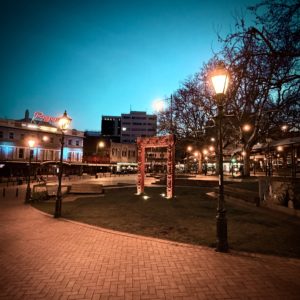
How I like fine and warm spring mornings, they have such a positive feel about them. Especially on a Saturday, when the city seems to take its time waking up. I was wandering through the centre of Dunedin on a Saturday morning when I found the streets around the Octagon looking surprisingly deserted. The sun was already high enough to catch the tops of the buildings, while the bare branches of the trees were beginning to hint that winter was finally on its way out.
There was hardly anyone about. A few cars, a couple of early shoppers and the odd person going about their business, but otherwise it felt strangely quiet for a Saturday morning. I assumed most of Dunedin had migrated towards the Farmers’ Market, leaving this part of town to the cafe owners and the pigeons.
For a moment, though, I quite liked having the city almost to myself. It made the familiar buildings, shopfronts and old street lamps seem somehow different, as if Dunedin had paused for a coffee before getting on with the weekend.
Daily Photo – Dunedin on a quiet Sunday afternoon.
I was exploring Dunedin on one of those quiet Sunday afternoons when the weather slowly seemed to engulf everything in its path. The hills of the Otago Peninsula were still visible, but only just, gradually disappearing behind a curtain of mist and low rain clouds.
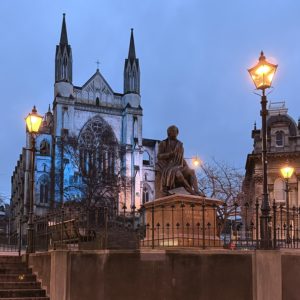
From where I was standing, the spire of First Church rose above the city, its stonework looking particularly impressive against the slate-grey sky. It’s one of those buildings that seems to turn up in almost every view of central Dunedin, and for good reason. It is difficult to miss. What caught my attention, though, was the way the weather had changed the whole character of the city. The modern glass buildings reflected what little light there was, while the older Victorian buildings below seemed to retreat into the gloom.
There wasn’t much happening. It was Sunday, after all. The streets were quiet, the harbour was almost still, and the rain was slowly swallowing the hills.
I took this photo of Lower Stuart Street early one morning, and just like much of Dunedin, it’s early surveyor Charles Kettle we can thank for it. In 1846 when Kettle arrived in Otago with the rather daunting task of turning what was largely wilderness into a new town. Working with his assistants, he surveyed the head of the harbour and began laying out the streets, sections and reserves that would become Dunedin. Kettle had studied Edinburgh before leaving Britain, and deliberately borrowed elements of its layout, including the broad streets, squares and central Octagon. The terrain, however, had other ideas. Hills, gullies, swamps and Bell Hill all got in the way, but Kettle pressed on. By the time the first settlers arrived in 1848, the basic town plan was largely complete.
The small wrinkle in the story starts with what we now know as Stuart Street. When Charles Kettle laid out Dunedin in his original survey, the street we call Stuart Street was actually called Albert Street. At some point the name was changed to Stuart Street, adding another Scottish connection to a town already filled with reminders of Edinburgh as Princes Street, George Street and Hanover Street had all been borrowed from the Scottish capital. Stuart Street followed the same pattern.
Daily Photo – Dunedin’s Traditional Chinese Garden
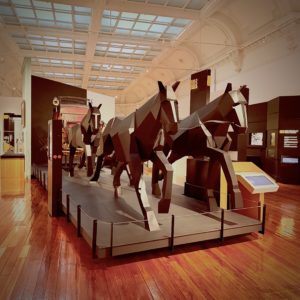
So this year is the Year of the Fire Horse, which, I’m led to believe, is supposed to be a year of optimism, opportunity and getting things moving. The Fire Horse is said to be energetic and dynamic, which sounds promising, although I’m beginning to think what the world really needs is a quiet afternoon and a cup of green tea.
Those born under the Horse are apparently hardworking, warm-hearted and fiercely independent, while the horse itself has long been associated with success, freedom and good fortune. So perhaps there’s something to look forward to. At the very least, it seems like a good year to saddle up, hold on tight and see where the road takes us.
I like photographs where two completely different buildings somehow end up having a conversation with each other. This is one of those. On the left, you have the modern building, all sharp lines, glass and those rather striking golden panels. Everything is clean and straight, almost as if someone has taken a ruler to the building and refused to let anything wander off course. Then sitting behind it is Consultancy House, which couldn’t be more different. All carved stone, arches, columns and those wonderfully industrial-looking external fire escapes climbing up the side. It belongs to another era entirely.
What I like about the photograph is the way the two buildings have ended up squeezed into the same frame. One is sleek and modern, the other slightly weathered and full of history. Yet somehow they work together. There’s also something quite satisfying about the shapes. The vertical lines of the modern building pull your eye upwards, while the older building fills in all the gaps behind it.
And then, of course, there’s that blue sky. Sometimes Dunedin does a pretty good job of providing its own backdrop.
Here in New Zealand, spring is just around the corner, and the first traces of it are already floating through the air, with pollen settling over everything like a fine yellow dust. But winter clearly isn’t quite ready to leave. Cold fronts have been rolling through with high winds, hail, snow on the hills and some seriously heavy rain.
We’ve had several bursts of torrential rain recently, including one particularly impressive cold snap that left massive puddles scattered across the city as Dunedin’s drainage systems struggled to keep up.
Normally, puddles are something you try to avoid. As a photographer, however, they’re a gift. Once the clouds finally broke and the sun appeared, those great sheets of water turned into giant mirrors, reflecting buildings, trees and the suddenly brighter sky. Sometimes the best photographs are hiding in the places you normally try not to step.
I have to say, I do like compositions where it’s possible to build up layers of city buildings without a scrap of sky. It takes a bit of moving around, a few adjustments, and a fair amount of patience, but when everything finally lines up, it creates an interesting effect. Your eye starts jumping from one building to the next, while your brain quietly tries to work out how all the pieces fit together.
The building in the centre of the photograph once had a mural by prominent international street artist Natalia Rak, titled Love Is in the Air. Unfortunately, it disappeared when the building was scheduled for repainting in 2024.
It was replaced by Palmerston North artist SwiftMantis. The original plan was to have a British bulldog gracing the wall, but animal welfare groups apparently objected. Exactly why, I’m still not entirely sure. It seems a slightly odd hill to die on, given that the dog was going to be painted on a wall and therefore unlikely to require feeding, walking or an annual visit to the vet. Still, this is Dunedin, where you learn never to underestimate the capacity of a perfectly ordinary wall to become unexpectedly complicated.
Anyway, the bulldog never made it onto the wall, and instead we now have a rather magnificent lion watching over proceedings.
Today’s photo was taken about 50 metres from yesterday’s, quite literally just around the corner. Funny how that works. You can wander through a city you think you know and still find yourself looking at something you’ve walked past a dozen times without really seeing it.
This part of Dunedin was once one of the busy bits of the country. Back when much of New Zealand’s wealth and commerce seemed to flow through Dunedin, the historic precinct was packed with businesses, warehouses, offices and people who had somewhere to be. These old buildings were part of the machinery of a growing city.
These days, things are a little quieter. People now come here for rather different reasons, including the Dunedin Street Art Trail and the work of London-based muralist and artist Phlegm. His mural has given this old corner a completely different sort of life, I rather like the contrast. Historic architecture on one side, contemporary street art on the other, and a camera somewhere in the middle trying to make sense of it all. It’s also right next door to the Dunedin Musicians Club. I think they have a regular Thursday jam session, although don’t rely entirely on me for that. If you’re interested, best check with the club, I’m sure they must have a website.
And that’s probably what I like about photographing places like this. The interesting thing isn’t always the big landmark. Sometimes it’s the little corner, just around the corner from yesterday’s photograph, where old Dunedin and new Dunedin happen to bump into each other.
I seem to be doing a bit of a Dunedin street-and-building thing this week. I’m not sure it really needs a name, and it certainly wasn’t intentional, but somehow I’ve ended up with a small collection of photographs taken around Dunedin’s Exchange area. They were all taken at different times and on completely different days, but I thought it might be fun to string them together over several posts.
This one was taken near the Provincial Hotel, not far from where the old Cobb & Co coaches once departed for the goldfields. Standing here and looking back down Princes Street towards the Octagon, you can almost start to imagine what this part of the city must have been like when the Exchange was one of Dunedin’s important commercial and social hubs.
Of course, the traffic has changed, the buildings have changed and most of the people have long since disappeared. But every now and then, the right light catches an old façade, a shadow falls across the street, and for a moment the past seems to sit just beneath the surface.
I found this quite by chance on one of my random strolls through the streets of Dunedin. There was a well-worn path leading off the footpath, so naturally I followed it. A minute or two later, I suddenly found myself standing in someone’s backyard.
It was immediately obvious that this had once been a residence of some note. These days, however, it is a student flat, and there were several clues to the change of ownership. The first was the several hundred empty beer bottles overflowing from a black plastic bin in the middle of what may once have been a tennis court. Around it sat several couches that had clearly seen better days, although they had been enthusiastically reclaimed by the greenery. One had even been sacrificed to the gods of academic study in what appeared to have been a rather successful backyard burning ceremony.
The house itself had also seen better days and is a long way removed from the grand Victorian villa designed in 1882 by architect John Burnside for businessman Robert Gillies. Built from bluestone and Oamaru stone, it was an impressive house for its time and even came complete with a rooftop astronomical observatory. Later it became known as Transit House and is now recognised as a place of historical significance. It was also the birthplace of Sir Harold Gillies, the pioneering plastic surgeon who went on to transform the treatment of soldiers with severe facial injuries during the First World War.
So there I was, standing in the backyard of a historically significant Dunedin house, surrounded by empty beer bottles, battered couches and the remains of a small bonfire. Somehow, it seemed very Dunedin.
Daily Photo – Dunedin Railway Station in ANZAC Square
They really knew how to construct buildings back in the day. Take the Dunedin Railway Station. When you’ve seen it once or twice, it’s easy to stroll by and not take much notice of it; however, if you stop and really take the whole building in, it really is quite impressive.
It’s the sort of building that seems to have been designed with the assumption that people might actually stop and look at it. There are towers, arches, columns, elaborate stonework and enough decorative detail to keep your eyes wandering around the place for quite some time. Even the garden that now sits in front of it feels like it belongs in front of a grand country estate rather than a railway station.
This is one of the many bridges that span the Yarra River in Melbourne. I think it’s called the Seafarers Bridge. Now, while the rest of today’s post has nothing to do with the Seafarers Bridge, simply mentioning both the Yarra River and bridges enables me to share with you the fact that Melbourne once had a morgue built into a bridge.
In the 1850s, Melbourne had a rather unpleasant problem. The Yarra had a habit of giving up its dead, and someone had to deal with the bodies when they appeared. So, beneath what is now Federation Square, at the eastern end of Princes Bridge the city built a morgue into the riverbank. It contained a deadhouse, an inquest court and even a laboratory, all tucked away beneath the bridge. The planners apparently thought this was best kept out of sight and intended to hide the whole grisly business behind shrubs, presumably so pedestrians could cross the bridge without having to contemplate quite how much death was passing beneath their feet.
When Jim Morrison and Ray Manzarek formed the band The Doors in 1965, Jim Morrison proposed the name ‘The Doors’ to symbolise breaking through everyday reality into the unknown. However, it wasn’t an entirely original concept. Morrison was blending two of his favourite literary influences, William Blake and Aldous Huxley. In his poem The Marriage of Heaven and Hell, William Blake wrote: “If the doors of perception were cleansed every thing would appear to man as it is, Infinite.” Whereas Aldous Huxley borrowed Blake’s phrase for the title of his famous book about psychedelic experiences, The Doors of Perception.
So, when a name for the band was needed, “The Doors” immediately came to mind. While they weren’t talking about physical doors, but rather how the mind receives, filters and processes reality through the cognitive filters of human consciousness, it’s still fun to wonder what might be beyond the random ones that pop up unexpectedly. In this case, I like to think a Dragon named Droofus but it’s more likely to be a stack of chairs.
There are a few things you can be certain of in Dunedin, one of which is never being too far away from a bush walk. Thankfully when the city was first planned by surveyor Frederick Tuckett and then later Charles Kettle, the first European settlers were smart enough not to flatten every single piece of hill and bush before turning them into roads and buildings! In fact, they even had the foresight to block off large sections of bush near the city to create an extensive town belt. Even if it was to create open spaces and natural green areas to alleviate slums, disease and crime, today it has turned out rather well and if they were around to see it, I’m sure they’d be rather pleased! Within 5 minutes of leaving the city centre you can be walking in replanted forest that is filled with native birds and on tracks that lead from the city centre to the higher hills suburbs which I think is simply splendid.
Here’s a photo I took one of of my wanderings. In 1876, when James Speight, Charles Greenslade and William Dawson handed in their notices at Dunedin’s Wellpark Brewery, it all worked out rather well. Between them, they had a useful combination of skills. Dawson was a brewer, Greenslade a maltster, and Speight a businessman. They leased a building on Rattray Street and went into business for themselves.
They mixed some malt and hops together and, impressed with the results, named the beverage Speight’s. More than 150 years later, the brewery remains on Rattray Street, where it has been ever since.
Daily Photo – Bridge On The Otago Harbour Cycleway
There’s something satisfying about a bridge that makes you stop and look before you cross it, or take a second look once across the other side.
This one is part of the Otago Harbour Cycleway and stretches across the Water of Leith with its cables pulling away in every direction. It turns what is essentially a fairly simple footbridge into something that looks rather more dramatic than it probably needs to be. From this angle, the lines all seem to converge on the centre, drawing you towards the other side.
I like places such as this. A bridge is usually somewhere you cross without thinking much about it. You are going from here to there, and the bit in between is simply something to get over. They’re not necessarily spectacular destinations, but they give you a reason to slow down.
Dunedin isn’t a bad place to live if you like walking. You’re never far from the beach, the bush or the harbour. You can head up into the hills for sweeping views or stay down on the flat, depending on what sort of walk you’re in the mood for.
This is one of my favourite harbour tracks, a place where several paths branch off in different directions, making it easy to turn a short stroll into a much longer wander. It can be a wild place when the wind funnels down the harbour, strong enough to make you lean into every step. But on a calm day, with the water shimmering and the hills reflected in the harbour, it’s a pretty good spot.
On a drizzly afternoon on Queen Street, I found myself standing in front of a rather wonderful reminder that Auckland wasn’t always made of glass, steel and buildings that look as though they were designed by the same person.
The Guardian building sits among the modern towers of the CBD, an ornate survivor from another Auckland, when buildings were built from completely different materials. Its neo-Renaissance façade is covered in the sort of detail that seems increasingly rare these days, from the grand columns of the entrance to the rather splendid copper-clad clock that hangs above the street. Once the home of the Auckland Stock Exchange, and the New Zealand Insurance Company’s administration, the only housing in the building was the caretaker’s flat on the eighth floor.
In the wet, the building seemed to take on an entirely different character. The rain-darkened pavement reflected the grey sky and the facade, softening the whole scene and making it look even more like a survivor from another time.
Not far from where I took this wonderfully geometric photograph is Dowling Street, a street that owes its origins to the need to make central Dunedin a more accessible place. It was while looking for information for my current series, Tales from the Devil’s Half-Acre, that I came across an interesting wee tale that I’d like to share.
When Dowling Street was first created, a substantial amount of blasting was required to form the cutting. The mayor at the time, John Barnes, awarded the job of supervising the work to his son, William, who, importantly as it turns out, had no qualifications whatsoever for the position.
What transpired was nothing more than an astonishing piece of bad luck and sensational tragedy. The blasting that took place, naturally enough, sent massive pieces of rock and boulders flying in all directions. One of these was catapulted through the air before crashing through the ceiling of a nearby business, striking a Mrs Finch.
Mrs Finch, the poor thing, just happened to be working quietly upstairs when the huge rock came crashing in from above. Naturally, it killed her instantly, and I dare say she wouldn’t have had the faintest idea what hit her!
I’d spent the evening dining on pizza and beer and, when at last it was time to depart, I settled the bill and went in search of a bus! Not more than a few minutes later, I spotted my means of transportation disappearing into the distance. I took this as a sign from the Universe, and one that must be followed immediately! So, I went back to the establishment I had just departed from, ordered another beer, and decided to study the bus timetable a little more carefully!
Another selection from my Live Feed with a mostly wintery feel and a few that haven’t been published yet. You can head over to the page right now using this link: Live Feed
Daily Photo – “I wander thro’ each charter’d street”
The first morning I was in Akaroa, I called into the farmers’ market and took the opportunity to have a slow wander around the various stalls. After poking my nose around for a while, I stopped at a food truck called Zed’s Shed and ordered a bacon butty for brunch before setting off in search of caffeine.
One of the good things about Akaroa is that the township is wonderfully suited to walking. Spread across several bays, you can happily spend your time aimlessly drifting in and out of shops, rummaging through shelves, or doing what I did: sit on a park bench while dripping grease and coffee down the front of my shirt, making it abundantly clear to everyone I met that I really shouldn’t be allowed to eat in public without a bib.