
Dunedin’s 1890 Code of Silence
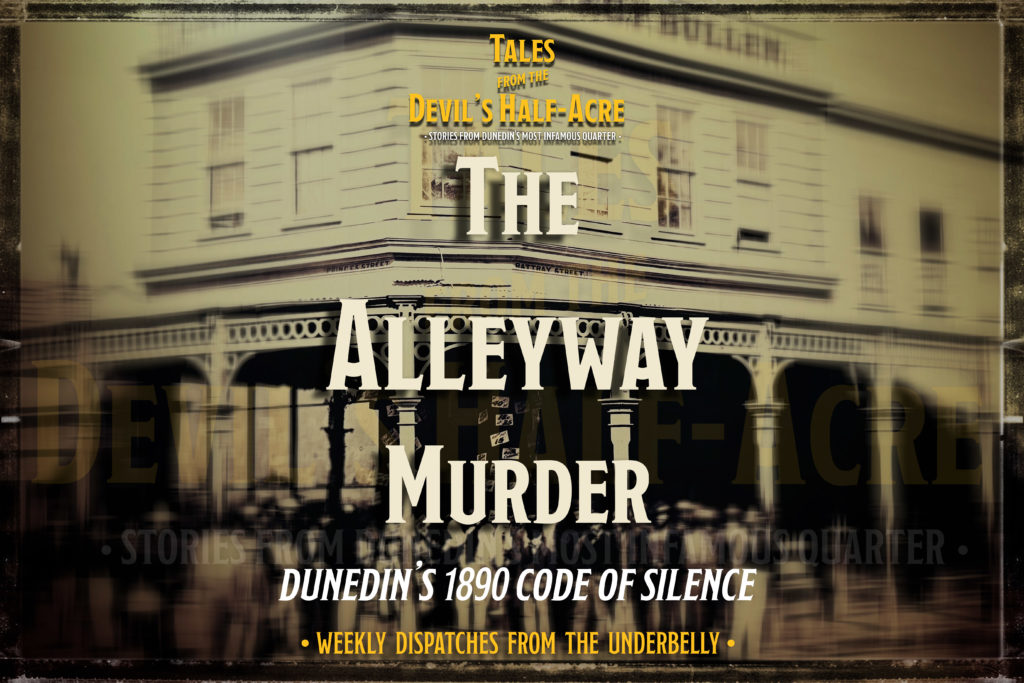
If you were to wander through Walker Street, or any of the alleyways that ran off it in the late 1860s, the first thing that would hit you, apart from the overwhelming, multi-layered stench of rotting food and human waste, was the sheer, improbable density of the place. Due to the Presbyterian Scottish settlement having been abruptly dropped into the middle of a gold rush, and thus struggling to maintain its respectable facade, it developed a remarkable knack for squeezing an astonishing number of unfortunate souls into spaces barely large enough for a modest wardrobe.
Take a well-known 1869 Stafford Street tenement that was a rough-swan timber-board building with a corrugated iron roof and, by modern standards, would probably have collapsed in a strong breeze. By 1869 standards however, it was a bustling human hive containing twenty-two tiny cubicles partitioned off by paper-thin walls, choked with strangers, where there was nowhere to go, no privacy, no soundproofing and little ventilation for those crammed inside.
Outside was just as bad. The whole area was bisected by thin, unlit lanes carved into the dirt on the hillside. It was precisely the sort of place where nobody noticed anything until it was entirely too late.
Enter William Mackenzie, a Tapanui resident who, on 29 October 1869, presented himself to the local constable and confessed to a murder some five years earlier. His story went something along the lines of: while walking along Walker Street one night, he was knocked down by a man who claimed to have witnessed William murdering his mate and naturally was seeking revenge. The man first attempted to choke him and then produced a knife. Reacting in fear for his life, our friend William grabbed his own knife and stabbed him. While sitting with the man until he died, two men and a lady appeared on the scene, saying that they had witnessed the whole affair and that he hadn’t murdered the man, they would have. They then offered William money and their address if he should ever need anything. He refused the money but called on them the next day in quite a state. He shared a drink or two, and remained in Dunedin for fourteen days before departing for the West Coast.
Having confessed to the murder five years previously, the Constable at Tapanui sent William to Dunedin where he was brought before the Resident Magistrate’s Court, and strangely enough this is where our story ends. Just what happened to the body, or to William Mackenzie, is hard to say. But if the stories are to be believed, and for fun, let’s assume they are, then at least two murders happened within minutes of each other, both of which were witnessed, neither resulting in the police being contacted. Nobody saw anything, and nobody heard anything.
A code of silence was already in place.
If we jump forward twenty-one years and peek behind those thin wooden walls in the quarter, we’d find that privacy was fiercely guarded, and trouble was overlooked until it spilled out onto the cobblestones. Yet, despite all of this, among the quarter where secrets were kept quiet, business was strictly mind-your-own, and the neighbourhood had learned to look the other way, there was the occasional touch of kindness and humanity among the slums. The unwritten code of the Devil’s Half-Acre in the 1890s was to keep silent. But beneath the notorious reputation, there was also a sense that the streets looked after their own.
Take the story of Findlay Sutherland, who lived on Poole’s right-of-way off Walker Street. It was cramped, claustrophobic, and tucked away in the shadows. Findlay lived a modest, quiet and somewhat solitary life as a working-class immigrant, which wasn’t unusual for the time.
So, on 17 September, when he hadn’t been sighted by his neighbours for several days, they began a search which eventually took them to his front door. When the door was kicked in, the smell that confronted them would have been so distinct and unsettling that it left no doubt in their minds that they were walking into a tragic scene. Following the discovery, it was determined that Findlay had died of natural causes. A local undertaker removed the body, and he was buried in an unheadstoned grave in the Southern Cemetery.
What all this tells us is that the quarter was a place with its own rules. People could quickly disappear and no one would know anything. Yet, among the steep, narrow streets, there remained a quiet empathy and communal spirit that existed alongside its notorious reputation. In some corners, that spirit survived by living outside the law.
Which is where we head next: the sly-grog houses and brothels that were born out of necessity, defiance and exploitation. Places where relationships were largely defined by one simple objective: keeping law enforcement at bay.
Next Dispatch: The Sly-Grog Queens