
Bootlegging Secrets and Survival in the Slums
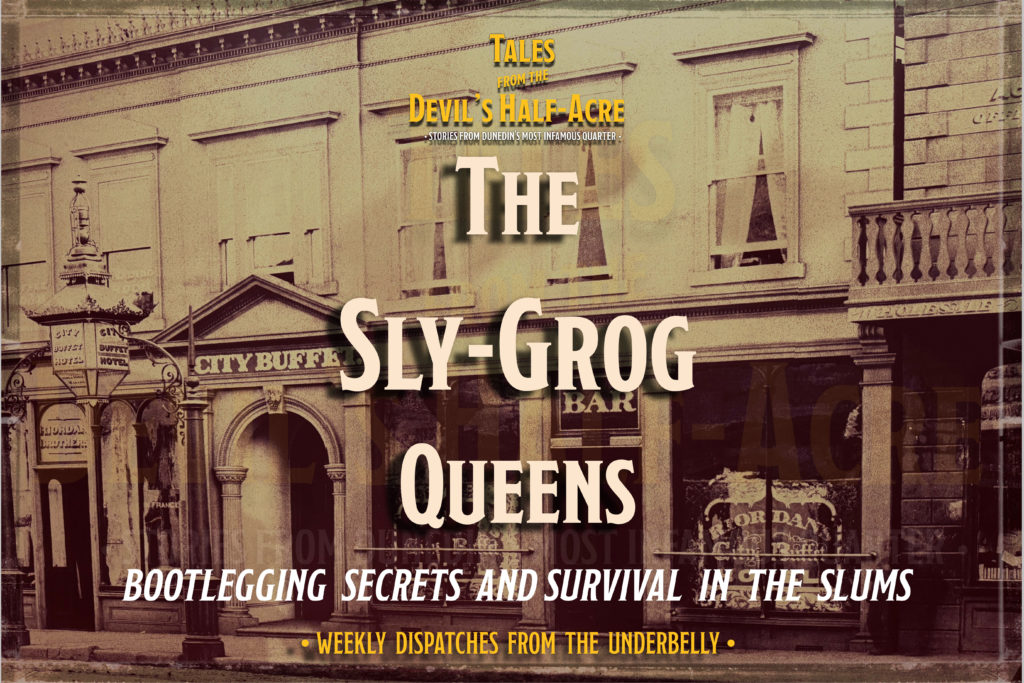
In the winter of 1870, Mary Ann Hall, the occupier of a house in Manor Place, appeared before the Mayor’s Court in Dunedin, charged with soliciting and being the owner of a property frequented by “jail birds and abandoned characters”. That Monday, the court heard evidence from the local police that in the earlier hours of Sunday morning, not only had Mary been found attempting to entice men down an alleyway quickie, but within her premises a commotion had developed where a man was attacked, bitten, and nearly kicked to death. She was subsequently given a three month prison sentence.
Next up on the bill was one Michael Ryan. His appearance before the Mayor’s Court was much shorter as he was discharged to receive medical treatment. It turns out that Michael had been in a house on Manor Place when a commotion arose that resulted in him being brutally kicked in the head and part of his fingers bitten off.
It seems the Manor Place had been a busy place that Sunday morning. Catherine Brown and Jane Stuart were arrested for using obscene language at 3am and were sentenced to three months imprisonment, Peter and Hugh Johnson were fined 10 shillings for drunkenness and disorderly behaviour, John Connor was fined 40 shillings for the same offense while further from Manor Place, Robert Brown was found so drunk that he had passed out in a water hole and was half-dead from the cold.
The Mayor’s Court in Dunedin on a Monday was always a busy time with a large amount of arrests happening over the weekend and steep fines imposed or gaol time imposed if they couldn’t pay. For many, a fine represented more than several days wages and with an inability to pay, residents like Mary quickly racked up lengthy court records.
If she wanted to make illegal Grog-Shop (her house) a legitimate business, it was a difficult and expensive process. The rules around opening establishments like these were tight and difficult to meet. For example, first Mary would need a Publican’s License that would cost her £30 to £40 per year, there would need to be a minimum number of furnished bedrooms, sitting rooms and stabling facilities required, there were ventilation, drainage and structural integrity inspections to pass, an illuminated oil or gas lamp was required to be lit over the front door at night, it had to shut by 11pm, the sale of alcohol was strictly banned on Sundays, Good Friday and Christmas day and if gambling, drunkenness, prostitution or riotous conduct was discovered on the premises – the license was immediately revoked.
For Mary, it was simply easier to buy a few bottles of whiskey, invite people around, charge a few pennies for a drink, a few pennies more for a bonk in the backroom, and if they got raided by the police, claim they were merely visiting and that the owner of the bottle had just skipped out the backdoor. For women like Mary (who wasn’t unknown to the court system), an appearance in the Mayor’s Court on a Monday morning wasn’t a rare thing. The fact is, for many women, without the income of a husband, or connections within the family to find employment, there were few options and ways to afford food and shelter for their family. Like so many people in the Devils Half-Acre, alcohol was cheap, provided an income and far too easy to get.
Take the story of Elizabeth Gore. Born into a respectable household, in 1888 she married William Henry Gore who came from a well-known Dunedin family. So, there was every expectation that they would live out their life together. They settled into a property on Walker Street, right in the heart of the Devil’s Half-Acre and went on to have two children. Unfortunately for Elizabeth, cheap alcohol quickly took over her life and fourteen years later husband William petitioned for divorce. In the years leading up to the divorce, Elizabeth’s alcoholism became such that the court was told she neglected the house, constantly argued and quarrelled with her husband, repeatedly disappeared for long periods of time, returning and begging for forgiveness. When the divorce was brought before the court, in her defence Elizabeth accused her husband of stabbing her with a knife. The couple’s ten-year-old daughter was then called to give evidence where she calmly and amazingly told the court that her mother had been drinking heavily and was so drunk she had thrust her arm through a window.
In an attempt to save his marriage, William moved the family to Mosgiel in the hopes that getting her away from Walker Street might save her. It didn’t. On one occasion, William came home to find her lying drunk on the floor and all the money in the house missing. After the divorce, Elizabeth found her way back to Walker Street where, like Mary Ann Hall, she racked up a long list of convictions, most relating in some form or another to alcohol and sly-grog dens. The end for Elizabeth, like so many in the Devils Half-Acre, wasn’t a pleasant or happy one. In September 1916, Elizabeth was found in Walker Street having died from heart failure following cirrhosis of the liver.
Finding alcohol wasn’t just a female domain. There wouldn’t have been the Grog-Dens without males willing to spend the cash or gamble into the night. Take this short tale involving Mr and Mrs Gullin.
On 1st March 1884, Eliza Gullin appeared before the Dunedin City Police Court in a matter relating to her husband, one John Gullin. Over the preceding days, months and years, Eliza had grown so sick of her husband wasting money, damaging property, endangering his health and the peace and happiness of the family home through excessive drinking in illegal grog-shops and slums, that she wanted him made a prohibited person. Rather than contest his wife’s claims, John made a promise to swear off alcohol and join the Blue Ribbon Army – a movement that encouraged people to wear a small blue ribbon as a public pledge of sobriety. The magistrate adjourned the case for a week to see if he kept his promise.
Whether John Gullin ever pinned a blue ribbon to his lapel, no one seems to have recorded. The newspapers fall silent after the hearing, leaving us to wonder if he embraced sobriety or simply returned to the nearest hotel. Whatever became of him, for one brief afternoon in March 1884, his future rested not on a sentence from the bench, but on a promise.
Yet, long after the pubs had closed and respectable Dunedin was asleep, another city was only just waking. In the narrow lanes behind Walker Street, light leaked through cracked windows while the smell of coal smoke mixed with something sweeter and more exotic. Behind one unmarked door, the quiet ritual of opium smoking was underway as pipes were passed from hand to hand and smoke curled lazily through the room while outside, two detectives waited in silence.
Before the night was over, the door would be forced open, evidence seized and another chapter added to the long, uneasy history of Dunedin’s Devil’s Half-Acre. Into The Opium Den Raid we go.
Next Dispatch: The Opium Den Raid