Daily Photo – Dunedin’s Traditional Chinese Garden
So this year is the Year of the Fire Horse, which, I’m led to believe, is supposed to be a year of optimism, opportunity and getting things moving. The Fire Horse is said to be energetic and dynamic, which sounds promising, although I’m beginning to think what the world really needs is a quiet afternoon and a cup of green tea.
Those born under the Horse are apparently hardworking, warm-hearted and fiercely independent, while the horse itself has long been associated with success, freedom and good fortune. So perhaps there’s something to look forward to. At the very least, it seems like a good year to saddle up, hold on tight and see where the road takes us.
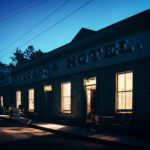
Daily Photo – Evening at the Railway Hotel in Winton
There are towns you can imagine being named after politicians, explorers or some long-forgotten gentleman with a suitably impressive beard. Then there is Winton.
The story begins in the late 1850s, when stockman Thomas Winton was moving through Southland in search of strayed cattle. At some point, he stopped beside a small stream and made camp. It was hardly the sort of event you would expect to leave much of a mark on history, but the stream became known as Winton Creek.
And then, as these things sometimes do, the name stuck.
When the Southland settlement was formally established in 1861 and the township surveyed in 1863, the fledgling town inherited the name of the stockman who had once camped beside its creek.
These days Winton sits about 30 kilometres north of Invercargill, a quiet Southland town surrounded by some of the country’s best grazing country. But long before there was a main street, a railway or a town clock, there was Thomas Winton, a drover, some wandering stock and a night spent beside a little stream.
Not a bad legacy for simply stopping for the night.
If you step off the track, it’s not hard to see why you might easily get disorientated and lost. There are many stories of people wandering off into the bush never to be seen again. One of the more famous is that of 10 year old Damian McKenzie. The story goes that in September of 1974, 10 year old Damian was attending a popular youth camp near Marysville in the State of Victoria where one of the activities was a walk to the popular Steavenson Falls, one of the state’s highest waterfalls, with a drop of at least 84 metres. The group, which included Damian, set off around 11:30am on Wednesday 4th September. Damian, a good natured and responsible young lad was said to have excitedly run ahead of the group up a track that eventually lead to the top of the falls. However, shortly after it was discovered that Damian was missing, two boys and an adult chaperone went to search for him. When there was no sign of him, the police were contacted. Over the preceding hours and days, the search party expanded to include the State Police, a trained Rescue squad, the Federation of Bush Walkers, Civil Defence, Australian Red Cross, Volunteers, 4wd and Helicopter patrols. In total upwards of 310 people were involved in the search across the landscape and into the rivers. All possibilities were considered: lost in the bush, drowned in the river, abducted, taken by natural predators, the possibility that he might have fallen down an old mineshaft was considered – even though they had mostly been filled in long ago. The search continued day after day with volunteers staying in the area for ten days after he went missing, yet no trace of Damian was found.
Fifty-one years later as the mystery had been labeled a ‘cold case’ and due to the fact that a coronial inquest was never conducted The Victorian Coroner re-examined the case in May 2026. On June 1, 2026 it was announced that the formal finding was that the definitive cause of death was exposure – legally ruling out any other long-standing theories. Among the evidence looked at was the fact that Damian went missing in an area surrounding Steavenson Falls consisting of incredibly dense, near-impenetrable scrub, steep slopes, and rugged bushland, wearing only jumper, jeans, and school shoes. Soon after the search commenced, the conditions turned nasty with freezing weather hitting the region including heavy mountain snow which heavily obscured tracks and disrupted search efforts. With no physical remains or items of clothing belonging to Damaian ever being recovered, he remains a missing person.
I like photographs where two completely different buildings somehow end up having a conversation with each other. This is one of those. On the left, you have the modern building, all sharp lines, glass and those rather striking golden panels. Everything is clean and straight, almost as if someone has taken a ruler to the building and refused to let anything wander off course. Then sitting behind it is Consultancy House, which couldn’t be more different. All carved stone, arches, columns and those wonderfully industrial-looking external fire escapes climbing up the side. It belongs to another era entirely.
What I like about the photograph is the way the two buildings have ended up squeezed into the same frame. One is sleek and modern, the other slightly weathered and full of history. Yet somehow they work together. There’s also something quite satisfying about the shapes. The vertical lines of the modern building pull your eye upwards, while the older building fills in all the gaps behind it.
And then, of course, there’s that blue sky. Sometimes Dunedin does a pretty good job of providing its own backdrop.
Here in New Zealand, spring is just around the corner, and the first traces of it are already floating through the air, with pollen settling over everything like a fine yellow dust. But winter clearly isn’t quite ready to leave. Cold fronts have been rolling through with high winds, hail, snow on the hills and some seriously heavy rain.
We’ve had several bursts of torrential rain recently, including one particularly impressive cold snap that left massive puddles scattered across the city as Dunedin’s drainage systems struggled to keep up.
Normally, puddles are something you try to avoid. As a photographer, however, they’re a gift. Once the clouds finally broke and the sun appeared, those great sheets of water turned into giant mirrors, reflecting buildings, trees and the suddenly brighter sky. Sometimes the best photographs are hiding in the places you normally try not to step.
I have to say, I do like compositions where it’s possible to build up layers of city buildings without a scrap of sky. It takes a bit of moving around, a few adjustments, and a fair amount of patience, but when everything finally lines up, it creates an interesting effect. Your eye starts jumping from one building to the next, while your brain quietly tries to work out how all the pieces fit together.
The building in the centre of the photograph once had a mural by prominent international street artist Natalia Rak, titled Love Is in the Air. Unfortunately, it disappeared when the building was scheduled for repainting in 2024.
It was replaced by Palmerston North artist SwiftMantis. The original plan was to have a British bulldog gracing the wall, but animal welfare groups apparently objected. Exactly why, I’m still not entirely sure. It seems a slightly odd hill to die on, given that the dog was going to be painted on a wall and therefore unlikely to require feeding, walking or an annual visit to the vet. Still, this is Dunedin, where you learn never to underestimate the capacity of a perfectly ordinary wall to become unexpectedly complicated.
Anyway, the bulldog never made it onto the wall, and instead we now have a rather magnificent lion watching over proceedings.
Today’s photo was taken about 50 metres from yesterday’s, quite literally just around the corner. Funny how that works. You can wander through a city you think you know and still find yourself looking at something you’ve walked past a dozen times without really seeing it.
This part of Dunedin was once one of the busy bits of the country. Back when much of New Zealand’s wealth and commerce seemed to flow through Dunedin, the historic precinct was packed with businesses, warehouses, offices and people who had somewhere to be. These old buildings were part of the machinery of a growing city.
These days, things are a little quieter. People now come here for rather different reasons, including the Dunedin Street Art Trail and the work of London-based muralist and artist Phlegm. His mural has given this old corner a completely different sort of life, I rather like the contrast. Historic architecture on one side, contemporary street art on the other, and a camera somewhere in the middle trying to make sense of it all. It’s also right next door to the Dunedin Musicians Club. I think they have a regular Thursday jam session, although don’t rely entirely on me for that. If you’re interested, best check with the club, I’m sure they must have a website.
And that’s probably what I like about photographing places like this. The interesting thing isn’t always the big landmark. Sometimes it’s the little corner, just around the corner from yesterday’s photograph, where old Dunedin and new Dunedin happen to bump into each other.
I seem to be doing a bit of a Dunedin street-and-building thing this week. I’m not sure it really needs a name, and it certainly wasn’t intentional, but somehow I’ve ended up with a small collection of photographs taken around Dunedin’s Exchange area. They were all taken at different times and on completely different days, but I thought it might be fun to string them together over several posts.
This one was taken near the Provincial Hotel, not far from where the old Cobb & Co coaches once departed for the goldfields. Standing here and looking back down Princes Street towards the Octagon, you can almost start to imagine what this part of the city must have been like when the Exchange was one of Dunedin’s important commercial and social hubs.
Of course, the traffic has changed, the buildings have changed and most of the people have long since disappeared. But every now and then, the right light catches an old façade, a shadow falls across the street, and for a moment the past seems to sit just beneath the surface.
I found this quite by chance on one of my random strolls through the streets of Dunedin. There was a well-worn path leading off the footpath, so naturally I followed it. A minute or two later, I suddenly found myself standing in someone’s backyard.
It was immediately obvious that this had once been a residence of some note. These days, however, it is a student flat, and there were several clues to the change of ownership. The first was the several hundred empty beer bottles overflowing from a black plastic bin in the middle of what may once have been a tennis court. Around it sat several couches that had clearly seen better days, although they had been enthusiastically reclaimed by the greenery. One had even been sacrificed to the gods of academic study in what appeared to have been a rather successful backyard burning ceremony.
The house itself had also seen better days and is a long way removed from the grand Victorian villa designed in 1882 by architect John Burnside for businessman Robert Gillies. Built from bluestone and Oamaru stone, it was an impressive house for its time and even came complete with a rooftop astronomical observatory. Later it became known as Transit House and is now recognised as a place of historical significance. It was also the birthplace of Sir Harold Gillies, the pioneering plastic surgeon who went on to transform the treatment of soldiers with severe facial injuries during the First World War.
So there I was, standing in the backyard of a historically significant Dunedin house, surrounded by empty beer bottles, battered couches and the remains of a small bonfire. Somehow, it seemed very Dunedin.
Daily Photo – Dunedin Railway Station in ANZAC Square
They really knew how to construct buildings back in the day. Take the Dunedin Railway Station. When you’ve seen it once or twice, it’s easy to stroll by and not take much notice of it; however, if you stop and really take the whole building in, it really is quite impressive.
It’s the sort of building that seems to have been designed with the assumption that people might actually stop and look at it. There are towers, arches, columns, elaborate stonework and enough decorative detail to keep your eyes wandering around the place for quite some time. Even the garden that now sits in front of it feels like it belongs in front of a grand country estate rather than a railway station.
I’d arrived at the Blue Lake after leaving State Highway 85 and bouncing along a gravel road for a while before finally reaching the tiny settlement of St Bathans.
After standing in the snow for a bit, I left St Bathans via the Loop Road, heading towards the tiny town of Ophir via Lauder and Omakau. The road took me through the old gold-mining settlement of Cambrian, with banks of snow lying either side of the road and the surrounding hills looking decidedly wintry, before eventually rejoining State Highway 85 at Becks. These days, Becks is little more than a name on the map with a pub, but once upon a time it was an important stopping point on the Cobb & Co coach route between the Dunstan and Maniototo goldfields. With a pub, of course and little else. So maybe Becks hasn’t changed that much after all.
As far as man-made lakes go, the Blue Lake at St Bathans is small but impressive, thanks to its striking colour. That’s due to the natural drainage from the surrounding hills filling the lake and mixing with all the leftover bright white quartz sediments, which reflect sunlight back through the clear, mineralised water, resulting in a stunning bluish-green colour.
It all started back in around 1863, when the search for gold brought miners to the area, which was known at the time as Dunstan Creek. Now called St Bathans, a bustling town of more than 2,000 people quickly grew.
One of the main ways to search for gold in the area was by sluicing, where powerful jets of water were blasted at banks of earth, washing gravel into sluice boxes. The boxes then trapped the gold at the bottom. In St Bathans, this method was so popular that the nearby Kildare Hill was transformed into a 168-metre-deep pit. It was only when the pit started getting too close to the town that mining was halted in 1934. Once mining stopped, the huge hole filled with water, creating the beautiful blue lake that we see today.
Having decided to spend a few days exploring Central Otago after a reasonably heavy snowfall, I’d stopped for the night in the small town of Waipiata. I’d eaten at the pub and washed it down with a few pints before retiring to bed at a reasonably sensible hour.
I awoke the next morning to discover that Central Otago had turned the cold up a few notches. A sharp frost had covered almost everything, while a low-lying mist hung over the countryside. The temperature gauge was hovering around -7°C, which is the sort of temperature that makes you question the thickness of the socks you’ve just put on.
After the usual morning ablutions, breakfast and a few cups of coffee, I was ready to head out and see what I could find. There was, however, one small problem. The car had spent the night outside and had apparently decided it wasn’t quite ready to face the morning and took a good fifteen minutes to persuade the ice covering the windows to give up its grip.
By the time I could actually see through the windscreen, my fingers were numb, the coffee had lost some of its appeal and I was beginning to wonder whether exploring Central Otago in the middle of winter had been quite such a good idea after all. Still, I was there, so there was really only one thing to do: get in the car and go exploring.
This is one of the many bridges that span the Yarra River in Melbourne. I think it’s called the Seafarers Bridge. Now, while the rest of today’s post has nothing to do with the Seafarers Bridge, simply mentioning both the Yarra River and bridges enables me to share with you the fact that Melbourne once had a morgue built into a bridge.
In the 1850s, Melbourne had a rather unpleasant problem. The Yarra had a habit of giving up its dead, and someone had to deal with the bodies when they appeared. So, beneath what is now Federation Square, at the eastern end of Princes Bridge the city built a morgue into the riverbank. It contained a deadhouse, an inquest court and even a laboratory, all tucked away beneath the bridge. The planners apparently thought this was best kept out of sight and intended to hide the whole grisly business behind shrubs, presumably so pedestrians could cross the bridge without having to contemplate quite how much death was passing beneath their feet.
When Jim Morrison and Ray Manzarek formed the band The Doors in 1965, Jim Morrison proposed the name ‘The Doors’ to symbolise breaking through everyday reality into the unknown. However, it wasn’t an entirely original concept. Morrison was blending two of his favourite literary influences, William Blake and Aldous Huxley. In his poem The Marriage of Heaven and Hell, William Blake wrote: “If the doors of perception were cleansed every thing would appear to man as it is, Infinite.” Whereas Aldous Huxley borrowed Blake’s phrase for the title of his famous book about psychedelic experiences, The Doors of Perception.
So, when a name for the band was needed, “The Doors” immediately came to mind. While they weren’t talking about physical doors, but rather how the mind receives, filters and processes reality through the cognitive filters of human consciousness, it’s still fun to wonder what might be beyond the random ones that pop up unexpectedly. In this case, I like to think a Dragon named Droofus but it’s more likely to be a stack of chairs.
I had to take this photo hand-held as I didn’t have my tripod with me, which created a few challenges. The least of these was waiting for the queues to clear so I could get the shot I wanted. Like yesterday’s post, it’s another photo of a human mask, but on this occasion, the person featured has a more sinister background and a story that is a tiny bit disturbing.
Tasmania resident Emma Williams arrived in Melbourne with her husband in 1893. Due to the economic depression, there was little work available and when Emma fell pregnant, it only added to their financial hardship. Once the baby was born, her husband left her, taking the baby with him.
With no form of income, Emma turned to sex work to survive. A second child soon arrived, but its incessant crying didn’t create an appealing atmosphere for men wanting a quickie, and having another mouth to feed didn’t make things any easier.
Unsure what to do, she could neither give the child away nor have him adopted. In August of that year, a young boy was found in the Port Melbourne lagoon with a stone tied around his neck.
Emma was hanged in Melbourne Gaol at 10am on November 4, 1895, for drowning her son.
I came across this life mask in the Akaroa Museum. It was created many, many years ago of Takatahara, a prominent 19th-century Māori chief. Upon closer inspection, I discovered that the backstory is a bit more complex. In March 1840, the French ship Astrolabe anchored at Otago Harbour. On board was Pierre-Alexandre Dumoutier, a French phrenologist collecting human head casts for the now-discredited pseudo-science of phrenology which essentially was measuring a person’s character, personality and IQ by feeling the bumps on a person’s head. While in New Zealand, Dumoutier managed to convince Takatahara to allow a plaster mold to be made of his head for future study by Dumoutier.
At the time, it was quite something as Takatahara was a formidable fighting chief and played a key role during a number of conflicts in the area. The thing is, this isn’t the actual life mask, it is a replica and was gifted to Akaroa in 1991 by French Prime Minister Michel Rocard.
At one point, this street was the busiest in New Zealand, which is kind of crazy to think about when you see it empty in the early morning hours. I came across this part of town one morning as rain showers drifted through, coating everything in a light sheen.
Time of day can have a dramatic impact on mood, giving places a completely different feel in the morning than they have at night. Predawn light has a crispness of its own, quite different from the softer, moodier light of evening.
Of course, there is another side to photographing places at that hour. Standing there in the half-light, camera on a tripod, you can’t help wondering, what the heck am I doing up at this ungodly hour?
Here’s a photo I took one of of my wanderings. In 1876, when James Speight, Charles Greenslade and William Dawson handed in their notices at Dunedin’s Wellpark Brewery, it all worked out rather well. Between them, they had a useful combination of skills. Dawson was a brewer, Greenslade a maltster, and Speight a businessman. They leased a building on Rattray Street and went into business for themselves.
They mixed some malt and hops together and, impressed with the results, named the beverage Speight’s. More than 150 years later, the brewery remains on Rattray Street, where it has been ever since.
Daily Photo – Bridge On The Otago Harbour Cycleway
There’s something satisfying about a bridge that makes you stop and look before you cross it, or take a second look once across the other side.
This one is part of the Otago Harbour Cycleway and stretches across the Water of Leith with its cables pulling away in every direction. It turns what is essentially a fairly simple footbridge into something that looks rather more dramatic than it probably needs to be. From this angle, the lines all seem to converge on the centre, drawing you towards the other side.
I like places such as this. A bridge is usually somewhere you cross without thinking much about it. You are going from here to there, and the bit in between is simply something to get over. They’re not necessarily spectacular destinations, but they give you a reason to slow down.
There is something about a snow-covered landscape that makes the world feel considerably larger than it usually does.
The familiar disappears beneath a blanket of white, fences become faint lines across the paddocks and the hills seem to stretch away forever. On a day like this, the landscape is reduced to a handful of colours and shapes: blue sky, white snow and the dark shadows where the hills fold into themselves.
I like the way snow changes the character of the countryside. A paddock that might normally look ordinary suddenly becomes something almost otherworldly. Every hollow and ridge catches the light, while the mountains in the distance seem to have been carefully carved from the landscape. There’s also a wonderful sense of emptiness. Not quite silence, there’s always the wind, but a feeling that the usual noise of the world has been turned down. For a photographer, snow is generous. It strips away the clutter and leaves behind the essentials. A fence line, a few scattered trees and a range of hills are suddenly enough.
Dunedin isn’t a bad place to live if you like walking. You’re never far from the beach, the bush or the harbour. You can head up into the hills for sweeping views or stay down on the flat, depending on what sort of walk you’re in the mood for.
This is one of my favourite harbour tracks, a place where several paths branch off in different directions, making it easy to turn a short stroll into a much longer wander. It can be a wild place when the wind funnels down the harbour, strong enough to make you lean into every step. But on a calm day, with the water shimmering and the hills reflected in the harbour, it’s a pretty good spot.
If you’ve explored the back roads and farm tracks high on the Otago Peninsula, you’ll known the weather never stays the same for long. One moment the hills are bathed in sunshine, the next they’re swallowed by heavy clouds rolling in from the Pacific.
I found this view looking back across the hills heading south, shafts of light broke through the cloud, catching the white surf below and the broad sweep of coastline in the distance. Beyond, mist drifted around the headlands, softening the horizon until sea and sky almost became one.
It’s moments like this that remind me why I rarely take the quickest route anywhere. The best views are usually found on the roads that wander, where changing light and unsettled weather can turn an ordinary drive into something worth remembering.
Driving through the Ida Valley during a recent snow dump, the scenery shifted dramatically. About 15 minutes before reaching Oturehua, the sharp blue sky vanished, dissolving the landscape into a ghostly white.
I took this around 3 pm, but with the temperature hovering at a freezing −5°C, there was no warmth left in the air. The heavy hoar frost and low mist drained every trace of colour and sound, leaving only absolute silence. The icy fence line is the only anchor guiding the eye through the haze, making Central Otago feel less like home and more like the edge of the world.
While exploring part of Central Otago during a recent snow dump, I passed this well-known cottage. On this occasion, the snow was piled high, creating what was almost a wall of snow on either side of the road. In a previous life, I believe this place was a general store and post office, meaning it would have been quite the community hub before people moved on and it spent many years as just another dilapidated building.
I’d been in Port Chalmers in the early part of the morning and, having completed a few errands, I headed back to Dunedin. It was one of those mornings when the weather hanging over the harbour seemed a little indecisive, and the higher clouds even more so. Along the drive to and from Port Chalmers, there are all these bays and inlets that create interesting shapes and views if you take the time to explore some of the roads that branched off State Highway 88. On this occasion the light kept changing with patches of brightness appearing through the clouds before disappearing again a few minutes later. It was the sort of day that encouraged a little wandering, so rather than simply heading home, I found myself taking the occasional detour, stopping whenever the road offered a different view across the water and towards the hills.
Daily Photo – Banks Peninsula from Lighthouse Road
On my first morning in Akaroa, I decided to do a little exploring of the French town on foot and spent the best part of the morning wandering in and out of shops, stopping at cafes and venturing out onto the jetties. When that was done, I took the car up into the hills to get a more scenic view of all the bays and inlets that there are to see. I headed up along Lighthouse Road, climbing steadily away from the town and into the hills, where the views seemed to open up with every turn. Below me, the peninsula stretched out in a wonderfully complicated collection of bays, coves and little fingers of water, with the surrounding hills rolling away into the distance. It was one of those drives where there was a temptation to stop every few minutes, simply because each bend in the road seemed to reveal another view that was even better than the last. From up there, it really was easy to understand why so many people seem to like Akaroa and the surrounding countryside.
On a drizzly afternoon on Queen Street, I found myself standing in front of a rather wonderful reminder that Auckland wasn’t always made of glass, steel and buildings that look as though they were designed by the same person.
The Guardian building sits among the modern towers of the CBD, an ornate survivor from another Auckland, when buildings were built from completely different materials. Its neo-Renaissance façade is covered in the sort of detail that seems increasingly rare these days, from the grand columns of the entrance to the rather splendid copper-clad clock that hangs above the street. Once the home of the Auckland Stock Exchange, and the New Zealand Insurance Company’s administration, the only housing in the building was the caretaker’s flat on the eighth floor.
In the wet, the building seemed to take on an entirely different character. The rain-darkened pavement reflected the grey sky and the facade, softening the whole scene and making it look even more like a survivor from another time.
Leaving Kokonga, or what I could see of it, I continued along Highway 87 as paddocks, sheds, farm buildings, hay bales and livestock came and went in the white, misty gloom. A short time later, I arrived in Kyeburn to find that things weren’t much better. However, as I headed towards Ranfurly, the skies gradually cleared, revealing a crisp, cloudless blue sky. A heavy blanket of fresh winter snow covered the rolling high-country hills, while dark tyre tracks cut through the fields, where wire fences stretched into the distance past scattered livestock braving the chill. All of this was backdropped by the majestic, snow-clad Hawkdun Ranges rising sharply against the horizon, the scene captured the serene, rugged beauty of a classic South Island landscape.
Not far from where I took this wonderfully geometric photograph is Dowling Street, a street that owes its origins to the need to make central Dunedin a more accessible place. It was while looking for information for my current series, Tales from the Devil’s Half-Acre, that I came across an interesting wee tale that I’d like to share.
When Dowling Street was first created, a substantial amount of blasting was required to form the cutting. The mayor at the time, John Barnes, awarded the job of supervising the work to his son, William, who, importantly as it turns out, had no qualifications whatsoever for the position.
What transpired was nothing more than an astonishing piece of bad luck and sensational tragedy. The blasting that took place, naturally enough, sent massive pieces of rock and boulders flying in all directions. One of these was catapulted through the air before crashing through the ceiling of a nearby business, striking a Mrs Finch.
Mrs Finch, the poor thing, just happened to be working quietly upstairs when the huge rock came crashing in from above. Naturally, it killed her instantly, and I dare say she wouldn’t have had the faintest idea what hit her!