The Secret Hidden Beneath Belfast City Hall

Daily Photo – Reflection of Belfast City Hill

If buildings could talk, Belfast City Hall would probably spend half its time gossiping about pigeons and the other half complaining about people climbing onto its lawns for the perfect photograph. Completed in 1906, it’s an absolute showpiece, built to celebrate Belfast’s brief but spectacular spell as one of the richest cities in the world. By day it’s impressive enough, but at night, when it’s bathed in coloured lights and reflected in rain-soaked pavement, it becomes one of those buildings that practically insists on having its photo taken.

The quirky part of its story, though, lies beneath your feet.

Hidden under the grand entrance is a sealed time capsule placed there when the foundation stone was laid in 1898. Packed inside are coins, newspapers and documents from Victorian Belfast, all intended for people who haven’t been born yet. It’s the architectural equivalent of stuffing things into the attic and hoping your great-grandchildren find them one day.

I rather like that idea. While thousands of tourists wander around admiring the domes, columns and Christmas lights, there’s a little snapshot of everyday Belfast quietly waiting underground. One day someone will eventually open it and discover what people considered worth preserving. Hopefully they’ll also find instructions on how to keep the pigeons off the statues, because judging by the evidence outside, that mystery still hasn’t been solved.

Curious for more? Explore more from a Small City.
Click here

A Visit to The Shankill Road

From the late 1960s to the late 1990s, Northern Ireland was gripped by “The Troubles”, a bitter nationalist conflict. On one side were republican paramilitaries (like the IRA and INLA), predominantly Catholic, who fought for a united Ireland. On the other were loyalist paramilitaries (like the UVF), predominantly Protestant, who fought to remain part of the United Kingdom. For today’s photo, we travel to The Shankill Road in Belfast, which became the heartland of the loyalist groups.

Daily Photo – Memorial wall, where the wreaths Rest


Major William Marchant
On a rainy Tuesday afternoon in April 1987, William Marchant stood outside the UVF’s headquarters above a Shankill Road chip shop. A hijacked car pulled up, and Provisional IRA gunmen opened fire, killing him instantly before abandoning the vehicle nearby. The IRA targeted Marchant because he was a high-ranking UVF figure, historically linked through intelligence reports and rumour to major loyalist operations, including the devastating 1974 Dublin and Monaghan bombings. His assassination was a calculated strike by republicans against the UVF’s leadership structure during a decade defined by intense, cyclical tit-for-tat violence between the rival factions.

Lieutenant Colonel James Trevor King
On June 16, 1994, senior UVF commander Trevor King was standing near a public phone box at the corner of Spiers Place, deep in conversation. Suddenly, a gunman from the Irish National Liberation Army (INLA), a republican splinter group, approached and opened fire. King was critically wounded and died of his injuries weeks later in hospital. The INLA carried out the hit to disrupt the loyalist command structure during a highly volatile period. With rumours of a ceasefire looming, paramilitary groups on both sides were aggressively targeting key figures to maximise their leverage before the political landscape shifted.

Volunteer David Hamilton
Davy Hamilton was standing beside Trevor King on that fateful June afternoon and was caught directly in the same sudden volley of INLA gunfire. He was rushed to hospital but died of his severe injuries the following day. King was the primary target of the attack, while Hamilton was an active UVF volunteer and part of the local command unit. The INLA struck them together, delivering a dual blow to the Shankill UVF’s operational core by capitalising on a rare moment when two key figures stood exposed on the open street.

Curious for more? Explore more from a Small City.

Click here

The Belfast Bean Stalk

Daily Photo – Victoria Square Shopping Centre

To clean and tidy up the city, Belfast officials poured £400 million pounds into a new complex which they named Victoria Square Shopping Centre. The crowning glory of the entire complex was a huge glass dome that sat an impressive 45 metres off the ground and provided an impressive 360-degree panoramic view of the Belfast skyline.

As impressive as all this was, the thing about building a viewing platform 40 metres in the air, under 635 panes, providing a 360-degree view of the city, is that once it is there, you have to get people up there to use it! This was solved by constructing what looks like a space-age plant from a futuristic version of ‘Jack and the Bean Stalk’. So everyone could see the wondrous complex on their way to the top, a glass elevator was installed so shoppers could soak up the vista on the way up, while a glass spiral staircase was wrapped around the outside for those feeling a bit more enthusiastic.

Earlier in the day, my wife and I had met up with a close family friend from home who happened to be in Belfast too, largely because she grew up in a village just down the road. Faced with the choice of catching up over coffee or joining me for a hike to the top of the dome to see the skyline, they had opted for the coffee, agreeing we’d all regroup once I’d finished.

Curious for more? Explore more from a Small City.
Click here

The Dome

Daily Photo – The Solar Sail in the Belfast Dome

When Belfast needed a central city upgrade after the signing of the Good Friday agreement in 1998,they poured £400 million pounds into a new complex which they named Victoria Square Shopping Centre. Its designers had ambitious and lofty goals with the crowning glory of the entire complex – the cherry on top if you will – was a huge glass dome that sat an impressive 45 metres off the ground. Made up of 635 individual triangular panes of glass held in place by a massive steel framework weighing 200,000 kilograms – it was the equivalent of roughly 40 adult elephants floating effortlessly above the city. When finished, the dome provided an impressive 360-degree panoramic view of the Belfast skyline, which the public could enjoy from a public viewing platform, offering views that stretch from the historic Belfast City Hall and the contours of Cavehill, all the way across to the towering yellow Harland and Wolff cranes in the Titanic Quarter.

The only problem with all of this was that engineers quickly discovered during the design process that what they had created was in actual fact a giant hotplate above the streets of Belfast. On the rare occasions that Belfast had a sunny day, the dome would act as a massive glasshouse and without intervention, the viewing platform and streets below would become unbearably hot. The solution was a stroke of genius. Instead of pulling the whole thing apart, the solution came in the form of a simple rotating fabric solar sail designed to track the sun throughout the day, filtering out the intense glare and heat of the Belfast sun, naturally regulating the open-air microclimate below so everyone could happily go about their day without having to worry about being burnt to a crisp or spontaneously combusting while shopping for socks!

Curious for more? Explore more from a Small City.

Click here

Pig’s Head In The Pottage Pot Gant

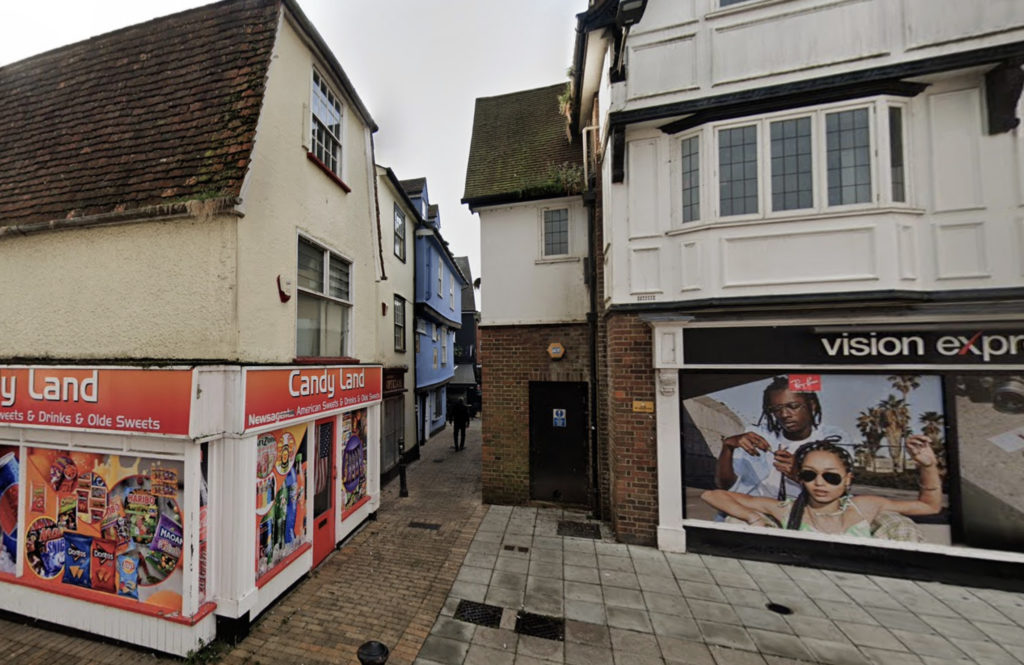
Pig’s Head in the Pottage Pot Gant (Google Street view)

In the 16th Century, a large number of Flemish weavers started migrating, making their way over to English places such as Lancashire, Yorkshire and Essex (including Braintree). As they did so, they turned the area into a major weaving region. In Braintree, where the buildings are tightly packed together, all sorts of alleyways were created that twisted and turned, eventually arriving at the old market square, where goods were sold. However, instead of being called alleyways, the paths were called ‘gants’, taken from the Flemish word ‘gang’ which meant corridor. So, in the town of Braintree, there are lots of small ‘gants’ throughout the town centre, one of which is called the ‘Pig’s Head in the Pottage Pot Gant‘. 

The usual name for this gant has been derived over history. In the deeds from the area dated 1753, an inn is referred to in the gant with the name of “Dogshead in the Porridge Pott” and over the passing of time, it morphed into its current name.