
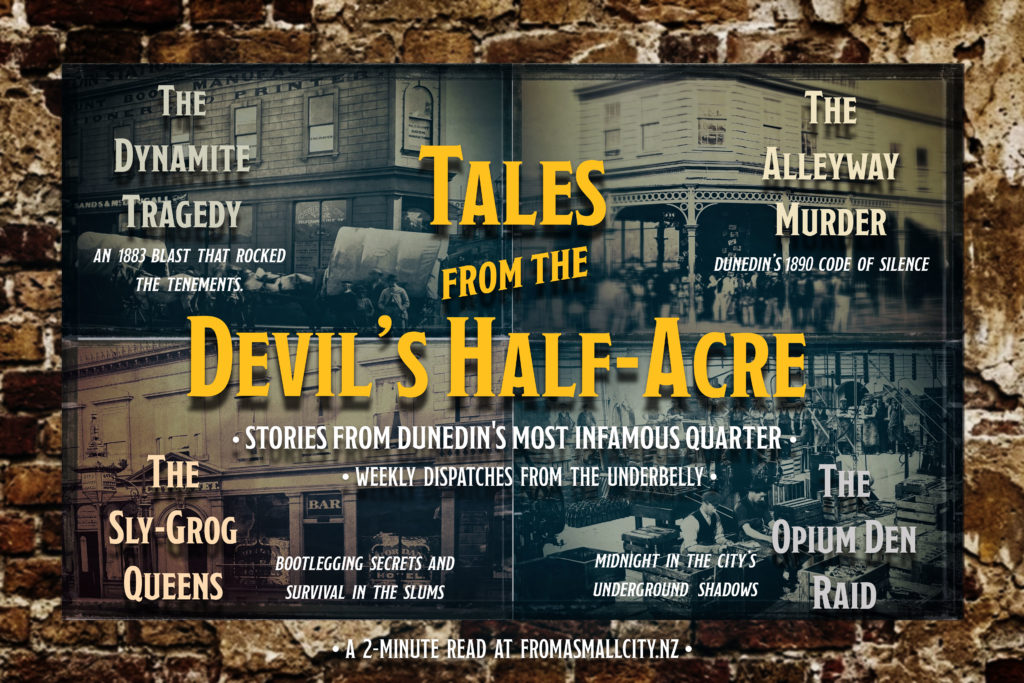
Weekly dispatches from the underbelly
https://fromasmallcity.nz/tales-from-the-devils-half-acre/
Editor’s Preface
Sometime on a rainy and idle Tuesday, with nothing much planned and left to my own devices, I decided to have a poke around a local museum to see what I could find. It was while wandering through the various periods of Dunedin’s history that I came across a small display featuring mug shots from the city’s darker side. What struck me was that the display wasn’t new. In fact, it had been there for years. Yet, for whatever reason, on this particular visit it caught my eye.
Of all the things I could have been doing that day, here I was staring at the faces of drug and alcohol addicts, prostitutes and gamblers from the late nineteenth century, people who had lived in slums where disease was as common as poverty. Every face seemed to wear the same expression of weary resignation, as though life had been just a little unfair. I couldn’t have told you who any of them were, although the small caption revealed that one woman was called Christina Lawson.
Later that evening, with those mug shots still rattling around in the back of my mind, I found myself wondering who these people actually were. I’m not entirely sure what I expected to find, but curiosity has a habit of getting the better of me. After a bit of digging, I discovered that Christina Lawson was remarkably well known to the local court system. By her mid-twenties she’d already collected around twenty convictions before being sentenced to a month of hard labour for larceny. More convictions followed over the years before she eventually drifted north to Christchurch, where she continued appearing before the courts for habitual drunkenness well into the early twentieth century.
The more I read, the more I found myself wondering what had become of her. Then I started wondering about everyone else. Who were they? How had they ended up there? What sort of lives had they lived? Before I knew it, I wasn’t really thinking about Christina Lawson anymore. I was thinking about Dunedin itself and the forgotten world that had existed beneath the respectable Victorian city.
The idea of exploring that forgotten world had a certain appeal. Normally, my first instinct is to pick up a camera, but this felt different. This was a story that would have to be told with words instead of photographs. Better still, I could go exploring without leaving the house, all from the comfort of my favourite chair with a pair of slippers on.
It was while I was following the life times of the unfortunate Christina Lawson that I noted police records show her operating as a “lady of the night” on what was then known as Walker Street An accompanying map showed the area to be known as the Devil’s Half-Acre. Enthralled by this term, and well and truly diving into this locally historic rabbit hole and feeling slightly embarrassed at my lack of local knowledge of an Dunedin criminal underbelly world that dated back to the time of the gold rush. I was well and truly hooked.
But before we can wander its muddy lanes and meet the people who lived there, we first need to understand how The Devil’s Half-Acre came to exist. Like so many Dunedin stories, it all begins with the discovery of gold and an influx of miners in the year of 1861.
When Gold Came to Town
The winter of 1861 in Dunedin was a particularly cold and miserable one. The modestly sized town was a mismatch of uneven streets carved out of the hillside and when it rained, the unpaved dirt tracks dissolved into high-deep quagmire. It was so notoriously bad that streets were almost impassable and the rickety timber structures that lined them were either in danger of collapsing or catching fire.
Yet, it was a time where the local landscape was about to quite literally change overnight. One lady noted how she went to bed with the familiar silhouette of Bell Hill covered in native mānuka scrub, with only a scattering of houses on its slopes visible from her home. In the morning, she was astonished and somewhat dumbfounded to see that her view of Bell Hill had changed dramatically. Overnight, the hillside had disappeared beneath a sea of white calico tents as hundreds of people had poured into town, all desperately searching for somewhere to stay.
The reason for this sudden invasion could be traced back to one man, Gabriel Read. An Australian farmer who had turned his hand to gold mining when he had arrived in Otago only a few months earlier. With life ticking along in obscurity for Gabriel Read, his future trajectory was fundamentally reshaped On 21 May 1861, when he struck gold near the town of Lawrence and we’re not talking about just a few lucky flakes here and there, either. This was enough to convince thousands of everyday people that out somewhere in the Otago backcountry, a life-changing fortune was just sitting there, waiting to be stumbled upon.
Over the preceding weeks, news travelled remarkably quickly. Suddenly Dunedin was filling with miners, merchants, labourers and drifters, all heading for the newly discovered goldfields in the hope of striking it rich. Ships arrived almost daily at Port Chalmers, each unloading another wave of hopeful fortune hunters. On one occasion, around a thousand miners arrived over just two days. The town simply wasn’t built to cope.
For reasons that can only end at the feet of Gabriel Read, Dunedin had transformed from little more than a quiet Scottish Presbyterian settlement of only a few thousand people to a population that had climbed to around 6,000, while the wider province had exploded to more than 30,000. What all this meant was that accommodation would disappear as quickly as it appeared. Those fortunate enough to secure a room counted themselves lucky while everyone else pitched tents wherever they could find a spare patch of ground. Before long, Bell Hill, reserves, vacant sections and muddy gullies were covered in tents, rough timber huts and hastily built shanties. There was little planning and even less regulation. Buildings sprang up wherever there was room, spilling across streams, climbing steep hillsides and crowding together in a jumble that had appeared almost as quickly as the gold rush itself.
As land around The Exchange became more valuable, rents rose just as quickly. Those who couldn’t afford them drifted onto the steep southern slopes overlooking the town. Sensing an opportunity, landowners hurriedly carved up their sections into tiny allotments, cramming them with cheap cottages, boarding houses and narrow alleyways. The result was a densely packed neighbourhood that was overcrowded almost from the moment it appeared.
By day, the area was a maze of muddy lanes, ramshackle buildings and overcrowded tenements where disease spread almost as quickly as gossip. By night, it became something else entirely. Sly grog shops came alive, gambling dens filled, brothels opened their doors and respectable citizens generally found somewhere else to be.
Weekly Dispatches From The Underbelly
So, now that we’ve got our bearings, it’s time to wander into Dunedin’s most notorious neighbourhood.
Over the coming weeks we’ll meet murderers, confidence tricksters, sly-grog sellers, prostitutes, policemen, opium smokers, gamblers and plenty of ordinary people who simply had the misfortune of living in the wrong place at the wrong time. Some stories are tragic, some are ridiculous, and a few are surprisingly funny.
We’ll begin next week by stepping inside a cramped tenement in The Devil’s Half-Acre to uncover the unhappy marriage of Mr and Mrs Stephenson – an ordinary married couple that slowly spiraled into a nightmare.
Next Dispatch: The Dynamite Tragedy